WELCOME TO HISTORY
8th grade students are currently studying a chapter called “The Civil War" (1861–1865)

8th grade will be examining the bloodiest war in American history. They will research and discuss the causes and effects of the Civil War and the impact it had on the future of our country as a whole. Students will complete a DBQ (document based question) analyzing the disagreements between the Copperheads and northern supporters of the Civil War. Both the North and the South were confident of victory at the start of the Civil War. The South had superior military leadership and the advantage of fighting a defensive war on its own territory. The North had a larger population, a strong industrial base, and more resources. Nevertheless, the Civil War lasted four violent years, tearing apart families and causing the death of more Americans than any other war in U.S. history.
At first, President Abraham Lincoln handled the issue of slavery carefully, keeping in mind that four border states with slaves remained in the Union. However, by 1862, Lincoln recognized that he needed to broaden the goals of the war. To announce a plan to free slaves, Lincoln waited for a Union victory, which he got at Antietam. Then on January 1, 1863, he issued the Emancipation Proclamation. Although it did not
immediately free slaves, it changed the war into one for freedom—a war to end slavery. The speech also paved the way to the Thirteenth Amendment (1865), which banned slavery in all the states of the unified nation. Ironically, although the Civil War was the bloodiest conflict the United States has ever fought, it served to reunite the nation instead of tearing it further apart.
7th grade students are studying a chapter called “The Era of Thomas Jefferson"
(1800–1814)
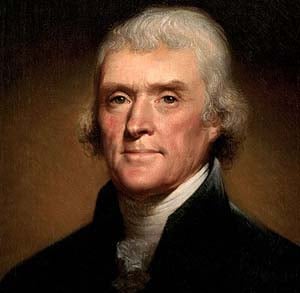
7th grade will be examining the importance of the Louisiana Purchase and the major accomplishments of the Jefferson administration. They will draft a document explaining New England’s opposition to the War of 1812, expressing the region’s views on the rights of states to challenge, or even separate from, the federal government. Although not initially intending it, Jefferson and his successor James Madison took the lead in directing a more active federal government. One major example of expanding federal power during this period is the Louisiana Purchase. Some critics said that Jefferson’s administration lacked constitutional authority to purchase new land, but Congress approved the treaty. The size of the United States was greatly expanded.
Jefferson was also in office during a landmark Supreme Court case, Marbury v. Madison, in which the court established its authority to review the constitutionality of laws. This decision strengthened the power of the judicial branch of government, making it an equal third partner in the three-branch government. It also had the effect of increasing the overall power of the federal government, because a stronger Supreme Court wielded more authority over the actions of the states.
6th grade students are currently studying a chapter called “Colonies Take Root" (1587–1752)
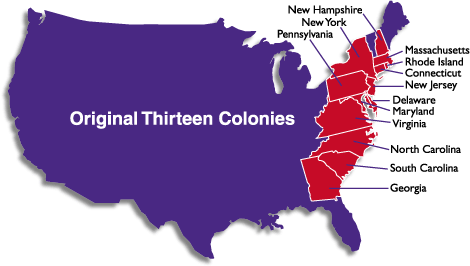
6th grade students will be completing a research project to determine the impact that the Mayflower Compact and Ordinance of Virginia had on the development of democratic government in America. They will also be examining the first English settlements and the original 13 colonies.
In the 1400s and 1500s, European nations were competing against one another to claim new lands in order to increase their countries’ wealth. The development of capitalist and mercantilist economies, which stressed the importance of colonies, amplified the desire to explore new lands. Having colonies in regions rich with natural resources would supply countries with raw materials for their industries and provide companies with markets for their goods.
Colonies soon began to establish unique cultural traditions that would help to shape the development of the United States as a nation. Colonists set up forms of representative government to establish order and ensure the survival and success of their colonies. Because many early colonists had migrated for religious reasons, the colonies implemented various policies toward religious practices—some allowing more freedom of religion than others. As the colonies matured, the issues of self- government and freedom of religion would continue to be important issues.